


a perfect storm
– a particularly violent storm arising from a rare combination of adverse meteorological factors.
– a particularly bad or critical state of affairs, arising from a number of negative and unpredictable factors.
Cambridge Dictionary
When we put our “ear to the ground”, read the pulse of the world as the year 2025 draws to an end, here is what we can see and feel.
A overall “pulse report” on the mood of the world’s peoples — feeling the mood especially of the the young ones, because “they will nherit the Earth.”
The Young People of this Earth, who are they?
Young people today — spanning Generation Z(born ~1996–2010) into early Generation Alpha — grew up immersed in digital worlds, not analog ones. This shapes how they perceive politics, work, community, identity, and risk.
They are the first truly global generation, linked by global media, common economic stagnation, and shared threats like climate change — yet also split up by profound disparities between regions.
As the world edges into 2026, the dominant mood among people is not one clear emotion but a layered state: alert, tired, adaptive, and quietly resolute. There is a widespread sense that life is continuing under strain rather than collapsing or triumphing. Things still function, but fewer people believe the systems guiding them are truly aligned with their long-term well-being.
Among younger generations, this feeling is sharper and more articulated. They are not confused about the state of the world. On the contrary, they are unusually well-informed, globally connected, and emotionally literate about risk. What they lack is not awareness, but reassurance that awareness leads to agency.
Many young people carry a background hum of anxiety about the future. Climate change sits at the center of this, not always as panic, but as a persistent awareness that the physical world they will inhabit is less stable than the one promised to earlier generations.
This anxiety is often paired with frustration: decisions that shape decades ahead are perceived as being made slowly, defensively, or without genuine youth participation. For some, activism becomes a channel for meaning; for others, the scale of the problem feels overwhelming and induces withdrawal rather than engagement.
Economic life contributes another layer of unease. Younger adults across regions sense that the old social contract has thinned. Education no longer guarantees stability. Work is available, but often precarious, underpaid, or disconnected from deeper purpose. At the same time, there is a strong desire for meaningful contribution, ethical coherence, and flexibility. The tension between aspiration and structural limitation produces a distinctive mix of pragmatism and quiet resentment. Many are adapting creatively rather than waiting for systems to fix themselves.
Politically, trust is low. Institutions are widely viewed as slow, self-protective, or captured by interests that do not reflect lived realities. This does not translate into apathy so much as a shift in form. Engagement is more decentralized, episodic, and digitally coordinated.
Protest movements tend to be issue-focused, leader-light, and emotionally charged. Young people are less invested in ideological purity and more concerned with whether actions produce tangible change.
Mental and emotional strainis part of the landscape, but it is not uniform despair.
What stands out is how openly it is discussed. Younger generations speak about stress, burnout, loneliness, and fear with a candor that would have been unusual a few decades ago. This openness is both a sign of vulnerability and a form of resilience.
Peer networks, shared language, and mutual recognition act as stabilizers even when formal support systems lag behind.
Culturally, younger people tend to hold more inclusive and pluralistic values, even in societies where public discourse is polarizing or regressive. There is a strong sense of global identification alongside local belonging.
Many feel connected to peers across borders through shared challenges rather than shared nationality. This produces empathy, but also a heightened awareness of inequality and injustice that can be emotionally taxing.
Overall, the prevailing mood among the world’s young is not one of naïve optimism, nor of nihilistic collapse. It is better described as watchful realism.
They expect difficulty. They assume disruption. They are prepared to adapt. What they are still searching for is evidence that effort, integrity, and imagination can meaningfully influence the trajectory ahead.
If there is a single emotional through-line, it is this: a generation that sees clearly, feels deeply, and is unwilling to be comforted by false reassurance, yet has not given up on the possibility that a different future could still be built.
That tension — between clear-eyed concern and stubborn persistence — is the pulse of the moment as 2026 approaches.
What are “the grownups saying about the state of the world, the analysts and the political scientists, the pundits ; D
2026 Risk Assessment
Let us look clear-eyed at the state of the world, lets see what the social and political scientist and the analysts are saying.
In 2026, global risks are characterized by a “structural shift” toward constant and accelerating volatility. Experts identify a “polycrisis” where independent threats like geopolitical conflict, climate disruption, and technological misuse intersect to create complex, hard-to-manage environments.
Geopolitical & Conflict Risks
• Russia-Ukraine Escalation:
The war enters its fourth year with concerns that both sides will intensify attacks on critical infrastructure and population centers.
There is a heightened risk of “gray-zone” provocations (sabotage, cyberattacks) by Russia against NATO countries.
• Middle East Instability:
Despite potential ceasefires, regional tensions involving Israel, Iran, and Hezbollah remain a high priority. Humanitarian conditions in Gaza are expected to remain catastrophic into 2026.
• Asia-Pacific Tensions:
China is projected to exert increased military and economic pressure on Taiwan and the South China Sea.
• State-Based Conflict:
Sudan is ranked as the country most likely to experience a deteriorating humanitarian crisis due to ongoing civil war.
Technological & Cyber Risks
• Dual Edge of AI:
AI is both a tool for defense and a force multiplier for threats. Malicious actors are expected to use AI for sophisticated scams, deepfakes, and automated cyberattacks.
• Cybersecurity & Systemic Risk:
Cyber threats remain the top global risk for organizations through 2028. Vulnerabilities in critical IT infrastructure and third-party dependencies are major concerns for 2026.
• Misinformation & Disinformation:
False narratives and deepfake content are identified as severe risks that could manipulate markets and erode trust in institutions.
Economic & Market Risks
• Trade Wars & Tariffs:
Geoeconomic confrontation, including potential “tariff wars” and the weaponization of trade, is expected to disrupt global supply chains.
• Inflation & Debt:
Persistent inflation and high global public debt—projected by the IMF to reach 115% of GDP—threaten financial stability.
• The “AI Bubble”:
There are significant concerns that an AI investment bubble could burst if tech companies fail to monetize the technology, potentially leading to a market crash and US recession.
Environmental & Societal Risks
• Extreme Weather Events:
Natural disasters like floods (aggravated by a La Niña cycle in early 2026) and wildfires continue to be top-tier risks.
• Activated Societies:
Rising inequality and grievance are driving social unrest, protests, and political polarization across both developed and developing nations.
• Critical Mineral Scarcity:
Geopolitical competition for minerals essential for digital and defense technologies is intensifying.
Top Humanitarian Crises in 2026
The International Rescue Committee (IRC) identifies the following as the top 5 countries at greatest risk of worsening crisis:
Sudan: Brutal civil war and famine.
Occupied Palestinian Territory: Destroyed conditions for life.
South Sudan: Risk of civil war return and economic turmoil.
Ethiopia: Regional tensions and severe climate shocks.
Haiti: Gang rule and political power vacuum.
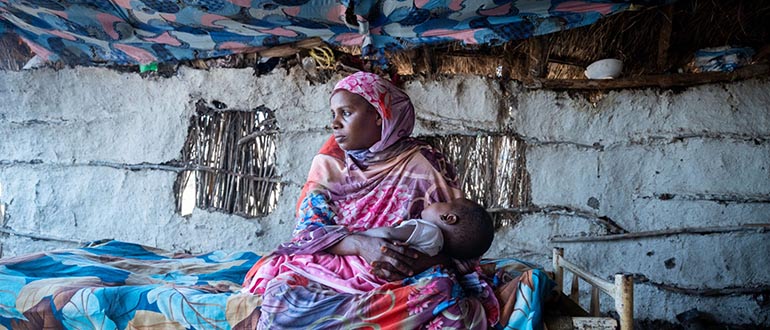
The top 10 crises the world can’t ignore in 2026