
Anger
The Fiery Energy
The Value of Righteous Anger
in the Face of Injustice and Wrongdoing
Jesus went up to Jerusalem. He found in the temple area those who sold oxen, sheep, and doves, as well as the money-changers seated there.
He made a whip out of cords and drove them all out of the temple area, with the sheep and oxen, and spilled the coins of the money-changers and overturned their tables, and to those who sold doves he said, “Take these out of here, and stop making my Father’s house a marketplace.”
The New Testament, John 2:13b-16
~
~~
~
I don’t really care if that is considered an eyewitness statement of a historic event or a Christian myth.
I read it as a universally applicable metaphor, almost as an archetype.
~
I have my own dealings with anger and a history to prove it. That does not make me an expert, but I think I have understood a thing or two about that fiery energy that is part of our makeup.
I guess I owe this to my father, who at times had a short temper that he could not control and that I feared as a kid. And in my youth, when I pretended to be a peace-loving hippie and sworn pacifist, i had simply suppressed all such volatile impulses of my deeper nature.
Severe stomach problems and a good therapist finally helped me to free the inner volcano, and off it went. To say that I was surprised of all the rage I had stored in my body would definitely be an understatement.
I could not believe the energies that showed up …
But here I actually don’t want to talk so much about my personal path of integrating anger into the whole spectrum of emotions; rather than that, I wish to contemplate anger in a bigger context and with special focus on the term “righteous anger.”
Which – in common languages is an inner force that says in no uncertain terms:
“Stop, that is enough!”
“Until here and no further!”
“I will not stand by and let this happen!”
“I will take a stand and speak my mind!”
“Or more!”
The emphasis is on the tone of the voice and the exclamation point!!!
A righteous anger can take many forms, individual and collective.
Here are a few examples how it looks when it becomes a collective expression.
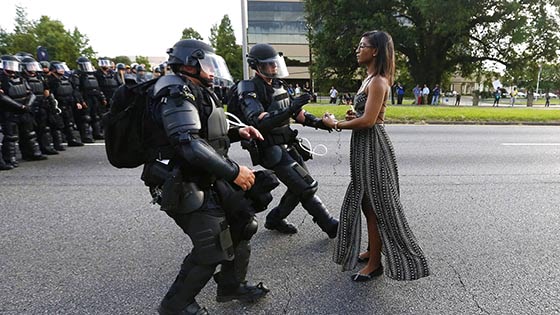
Black Lives Matter protests – Batton Rouge USA 2016

Tiananmen Square student protests protests – China 1989

Citizen protest against ICE – Minneapolis USA 2026

Citizen protest against ICE – Los Angeles USA 2026
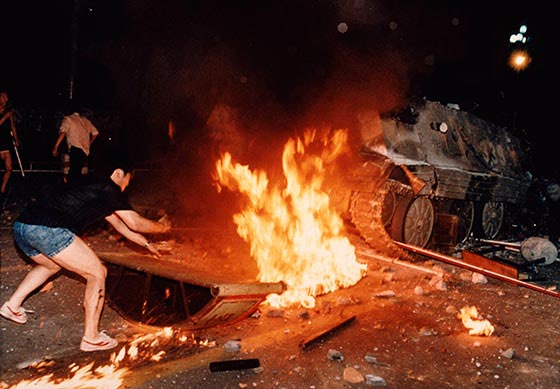
Hong Kong Independency protests 2019
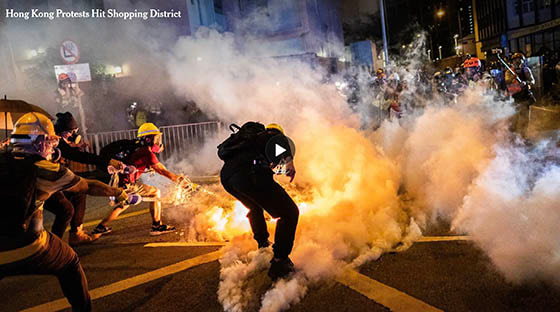
Hong Kong protests 2019
It can – and has – literally become hot rage and set the world on fire.
~
~~
~
I had already been writing about Donald Trump in 2017, when he first became president, expressing my instinctive disgust about the fact that such a twisted and immoral mind could be voted by the people to lead the most economically and militarily powerful nation on Earth.
Now with this astonishing “Second Coming of Trump” – no pun intended – my articles have become more frequent and sharper in tone.
And when I talk to some of my US American friends, I hear more often than not a fatigue and a reaction to the events that says:
“Relax Cris, you have to calm down!”
“Why do you make it your business?”
“You have some anger issues, relax mate!”
Ok, I can get hot when I see bullshit happening, and it seems people have already normalized it in their response to it.
I can’t, and I don’t want to normalize wrongdoing by looking away and moving on!
Maybe I should really take a Xanax, as somebody suggested recently 😉
~
~~
~
The story of Anger
I think that anger has acquired a bad reputation in modern culture.
It is often seen as a failure of emotional regulation, a moral weakness, or a primitive impulse that must be subdued.
I guess this condemnation confuses destructive anger with a similar yet very different emotion.
Righteous anger – the clear, grounded response to injustice, violation, and moral transgression.
Righteous anger is not rage. It is not loss of control. It is a legitimate response of my organism and my conscience saying,
“This should not be happening.”
About the biological and psychological roots of anger
I think that its core, anger is a boundary-protecting emotion.
As far as I understand the biology of it, anger is part of the threat-response system, a reaction rooted in our evolutionary past.
When a human perceives disturbance, violation, or obstruction of core values, the nervous system mobilizes energy, and the symptoms are increased heart rate, adrenaline release, and heightened focus.
In this perspective anger is not a flaw. It is preparation for action.
The two-edged sword of anger
Without anger, humans become passive in the face of harm.
Without modulation, anger becomes destructive.
The issue is not anger itself, but its degree, clarity, and direction.
Levels of Anger
From Signal to Destruction
Anger exists on a spectrum:
At the lowest level is irritation – a mild, instinctive signal that something is off. It often goes unspoken and unresolved.
The next level up is what I would call assertive anger, where I clearly state my boundary, where I “draw a line in the sand”:
“Stop. This is not acceptable.”
On a personal level, I think this is the healthiest and most socially useful form of expressing anger.
Then there is moral anger, arising when personal boundaries expand into ethical ones – when violation and perceived harm affect others, systems, or shared values.
This is where righteous anger is born.
Beyond this lies rage, where regulation collapses. Rage narrows perception, overwhelms judgment, and often replaces moral clarity with indiscriminate aggression.
This kind of fiery rage is often on display during mass protests against police overreach or during revolutions against authoritarian regimes.
Righteous anger lives in the spectrum below rage and above irritation. It is energizing for action but conscious and directed. It does not seek destruction.
It seeks correction of something that is perceived as wrong.
The Moral Function of Righteous Anger
Righteous anger restores moral reality.
In unjust situations, wrongdoing often relies on normalization and silence. Anger breaks the spell. It says: No. This is not normal.
It mobilizes courage.
Fear alone rarely produces ethical action. Anger provides the heat, the inner fire required to confront power, speak truth, and risk disapproval and even persecution. In extreme situations, even the possibility of death.
It protects dignity.
Chronic suppression of justified anger leads to resignation, depression, and internalized shame. Naming injustice preserves self-respect.
I think historically, nearly every meaningful justice movement or human rights movement has been powered by disciplined moral anger – from Mahatma Gandhi to Martin Luther King, who spoke explicitly of anger transformed into nonviolent force rather than denied or erased.
When Anger Turns Toxic and destructive
Anger becomes destructive when it loses proportionality, clarity of the target, or ethical grounding.
Psychology has a lot to say about anger dysfunctions:
Unprocessed anger can turn inward, manifesting as self-contempt or despair.
Disowned anger can be projected outward, turning moral outrage into hatred of entire groups.
Chronic anger, detached from action, corrodes both body and psyche – contributing to stress-related illness and breakdown of the ability to relate.
I think that the solution is not suppression, but integration:
feeling anger fully, understanding its message, and choosing how to act from it.
Righteous Anger and Self-Regulation
Contrary to popular belief, i think that righteous anger is often a sign of emotional maturity.
Emotional maturity does not mean remaining calm at all costs. It means responding truthfully and proportionately.
Healthy regulation does not extinguish anger, but it channels it. Into speaking out, setting boundaries, protesting, attempting repair, and when possible, reconciliation.
Anger that is internally processed can become a tool for resolve.
Anger that is denied becomes poison.
Righteous anger as a necessary cleaning Fire
When a society pathologizes all anger, it quietly trains its members to tolerate injustice. A person who never allows themselves righteous anger becomes adaptable – but not free.
Righteous anger is a necessary fire. It burns illusions. It demands accountability. It is the emotional engine behind saying enough – to abuse, corruption, deception, and moral cowardice.
I think that the task is not to get rid of anger but to educate it and use it wisely.
This kind of anger does not make us dangerous but empowered.
I hear that these days in Minneapolis/USA, a whole population is already practicing a new form of protest against ICE brutality and intimidation: being quietly present in the streets, witnessing, video documenting, and so on.
Grassroots groups have formed to teach skills learned from Gandhi and de-escalation theory, skills to channel anger and righteous indignation into a constructive force of change.
~
~~
~
Tools for Cultivating Wise Anger
No matter if the perceived irritation or wrongdoing is personal or collective, some tools are helpful to deal with the situation.
Self-Awareness
Understanding my anger first and foremost requires honest self-examination.
What triggers my anger? Is my angry reaction proportional to the harm that I perceive, or do I rage at minor slights to get rid of an inner stockpile of suppressed anger?
Are we angrier when our family or in-group is harmed than when identical harms affect others?
I think such questions can help to distinguish genuine moral response from ego protection or tribal bias.
Emotional Distinction
When I am able to make fine distinctions between emotional states – for example distinguishing irritation from frustration from disappointment from indignation – I will be able to regulate those emotions more effectively.
Developing a richer vocabulary for anger, recognizing the difference between irritation, outrage, indignation, and fury, allows for more precise and appropriate responses.
Speaking from my own dealings with my anger-response, I know thats a lot to ask from a mass of people in a protest movement 😉
But hey! Why not?
The Pause Technique
Between stimulus and response lies a space, which every practitioner of Vipassana Meditation learns to know very well.
In that space resides our freedom to choose.
Cultivating the ability to pause – even very briefly – before acting on anger allows for internal neurological regulation to take place.
Mindfulness practices, cognitive-behavioral techniques, and simple counting to ten can help to widen this crucial gap.
Channel righteous anger. Don’t suppress it
The alternative to explosive anger is not suppression but channeling it into creative and constructive action.
Righteous anger can be consciously used for
– Speaking truth to power, raising awareness, challenging unjust policies
– Building movements, creating solidarity, mobilizing collective action
– Art, writing, music that gives voice to injustice and imagines alternatives
– Asserting dignity, refusing complicity, protecting the vulnerable
– Sustained commitment, maintaining engagement with difficult issues over time
The anger that drives these actions differs from the anger that seeks to retaliate, destroy, and do the an-eye-for-an-eye spiral of violence.
It is anger’s potential to be in service of repair, not mere destruction.
Anger as Moral Fuel, Wisdom as Navigation
In a world that is in the convulsions of a mega-crisis, more confusing, disruptive, corrupt, and unjust at every turn, we have to be wise in how we respond to situations that unexpectedly happen to us.
See no evil, hear no evil, speak no evil 🙈🙉🙊 will at some point not be an option anymore.
Becoming a vigilante or even an anarchist like we see in post-apocalyptic movies is still a while off – I hope.
But knowing what’s going on, having information, and creating a good skill set is a wise thing to do.
Waiting and hoping is no answer to social upheaval and challenging times.
I believe that righteous anger is a powerful moral energy that requires skillful direction.
Like fire, it can warm or burn, forge or destroy.
The question is not whether to feel anger in the face of injustice – such anger is often the appropriate response of a moral being to a broken world – but how to honor that anger while preventing it from consuming us or becoming the very injustice we oppose.
The value of righteous anger lies in its capacity to wake us up, to break through complacency and complicity, and to mobilize our moral energies toward justice.
We need both the anger and the wisdom. The fire and the container.
In a world where injustice persists and even seems to pile up, where the powerful exploit the vulnerable, and where systems of oppression grind on despite their evident wrongness, anger has its place.
But it must be an anger channeled by humility, guided by compassion, and committed to building rather than merely burning down.
The esteemed psychologist Peter Levine named is “embodied anger”. Anger that we can feel fully, understand clearly, and express constructively.
Fully conscious emotional fire energy.
Handle with care!
The path forward is not to eliminate our capacity for moral outrage but to develop the discernment to direct it wisely.
To be angry about things worth being angry about. To act on that anger in ways that serve justice rather than mere vengeance.
To sustain our engagement with difficulty without destroying ourselves or others in the process.
The Art of Righteous Anger
Feeling deeply enough to act, seeing clearly enough to act well, and holding ourselves accountable for ensuring that our anger serves the world’s healing rather than its further wounding.
Sounds easy peasy, right?