[Press PLAY to listen to a reading of this article.]
Crossing the Rainbow Bridge
Antahkarana
Bridging Lower Mind and Higher Mind
Personality and Soul/Monad
An attempt to clarify its meaning
listen ➡
Itinerary / a map & overview / shortcuts to specific chapters
- Itinerary / Chapter Overview
- Introduction, Context and Intention
- The Vedic Foundation – Defining The Four-Fold Inner Instrument.
- Theosophical Metaphysical Teachings / Alice Bailey and the Rainbow Bridge.
- Building the Bridge. How To Do It.
- New Age Interpretations. Ascension, Channeling, and Contemporary Practice. A word of Caution.
- Contemporary Application of Anthakarana Teachings.
- Conclusion. The Bridge That Must Be Built.
Itinerary / a overview
shortcuts to specific chaptersx
- Itinerary / Chapter Overview
- Introduction, Context and Intention
- The Vedic Foundation – Defining The Four-Fold Inner Instrument.
- Theosophical Metaphysical Teachings / Alice Bailey and the Rainbow Bridge.
- Building the Bridge. How To Do It.
- New Age Interpretations. Ascension, Channeling, and Contemporary Practice. A word of Caution.
- Contemporary Application of Anthakarana Teachings.
- Conclusion. The Bridge That Must Be Built.
listen ➡
I am taking up this somewhat exotic sounding topic once again, because I have been asked about it, just yesterday. That is probably just one reason.
The other one(s) are:
– This is very timely matter since we humans are is dire straits here on our planet. A crucial junction ahead, I would say. Humanity can go forward or slip back wards with devastating consequences.
Individually as well as collectively we seem to be at a bottleneck in the evolution of our consciousness. This is reflected by the utter aimlessness that reigns the political debate of many nations and the radical geopolitical turmoils that you can read about in the news.
And the mounting evolutionary pressure is visible in the confusion that can be witnessed on the World Wide Web, instagram and social media.
At least that what I sense and see.
On the other hand, we never had so many opportunities to learn, study, take advantage of information and all the wisdom of the ages.
It should be possible – at least I feel that way – to change our basic attitude from self-centered grabbing to one of wold-centered giving.
Which would be a clear indicator that we have taken a necessary step from a personality-centric to soul-centric approach to life.
The crossing of the Rainbow Bridge.
– A lot of my writing in recent years has actually been focussing on topics that are closely related to this faithful transition that every individual eventually has to take. And I hope the whole humanity will one day be able to make the fundamental shift from separation/duality to union/one-ness.
My personal view of Antahkarana.
All such thoughts make me contemplate what I actually think and feel and know about this mystical and mythical Rainbow Bridge.
Antahkarana is a beautiful Sanskrit word, ages old from the time of the Vedas. Always sounded attractive, quite exotic, esoteric and mystical to me.
I heard about it from my Indian meditation teacher/guru in the 1970s. He was not much into explaining things and he warned about the intellectualizing of spiritual concepts.
Obviously, I did not listen to him because some yers later I used the first opportunity to find a good spiritual bookstore and there found the writings of Alice Bailey. Which told me more than I actually could digest at that time.
🤣
More about Bailey and her Teachings on the Antahkarana later in the article.
But to make the long story short, the Rainbow Bridge and what it represents has been integral part of my personal spiritual life path ever since. And also the basis of my professional work with clients:
The clearing, healing, stabilizing and solid grounding of the personality in order to open up to Soul and further to the Monad/Spirit.
So that a clear and undisturbed flow of spiritual light, universal wisdom and unconditional love can descent and illuminate the persona and his/her actions in this space/time dimension of Earth.
All that is the motivation and backdrop for my contemplation for this article. Besides my own experience and thinking, I will mainly share information based on two Wisdom Teachings:
– The Vedic teachings that originated the concept of Antahkarana thousands of years ago,
– and the metaphysical explanations that came from the Theosophy and later from Alice Bailey and her Tibetan sources.
I also feel compelled to sound a word of caution about the use of those concepts by certain New Age speakers on Youtube and the awful commercialization that seemed to mushroom there in recent years.
More about that later.
listen ➡
Antahkarana.
The Inner Instrument and the Rainbow Bridge.
From Vedic Psychology to
Theosophical Esotericism
to New Age Ascension.
The Sanskrit term Antahkarana and the associated esoteric teachings have left breadcrumbs through the millennia and across spiritual traditions, evolving from a precise technical term in Hindu Vedic philosophy into a central concept in Western esoteric teachings and the New Age spiritual marketplace.
Antaḥkaraṇa refers to the totality of the mind, including our thinking faculty, the sense of I-ness, and our discriminating faculty.
~
~~
~
The Vedic Foundation – The Four-Fold Inner Instrument.
The Original Vedic Definition and Meaning.
In Hindu philosophy, the antahkarana is composed of the four functions of the mind:
– the manas (the mind or lower mind),
– buddhi (the intellect or higher mind),
– ahamkara (ego or I-maker).
– chitta (memory or consciousness).
Commonly simplified to mean “the mind,” antaḥkaraṇa comes from the Sanskrit compound:
“antar,” meaning interior or within, and “karaṇa,” meaning sense organ or cause.
Therefore, antaḥkaraṇa is the inner cause or internal “organ” that controls the entire psychological process, including emotions.
The Four Components.
Manas – The Lower Mind.
Manas is the processing faculty that receives sensory impressions from the external world and internal states. It functions as the coordinator between sense organs and the discriminating intellect. Manas is characterized by doubt, questioning, and vacillation—constantly moving between options without final determination.
We all know this state or level of mind, the ever chatting monkey that is hard to stop. Worrying, planning, ruminating, anticipating. Seldom at peace with what simply is.
In Vedantic understanding, manas operates at the level of nama-rupa (name and form), dealing with the differentiated multiplicity of phenomenal experience. It is the level at which we experience the world as separate objects with distinct identities.
Buddhi – The Higher Mind or Intellect.
Buddhi is the intellect or higher mind, the faculty of discrimination and decision. Manas has doubts, buddhi has determination.
It is the seat of wisdom, judgment, and discernment—the capacity to distinguish between real and unreal, permanent and temporary, self and not-self.
Buddhi represents the first level of clarity emerging from the confusion of manas.
It is through developed buddhi that we can perform discrimination and equilibrium/detachment, essential prerequisites for spiritual realization.
Chitta – Memory and Consciousness Substrate.
Chitta is the storehouse of all impressions, memories, and latent tendencies – samskaras.
It functions as both memory and the underlying field of consciousness itself. Chitta represents consciousness in its most general sense—the ground from which all mental functions arise.
Chitta holds the karmic imprints that condition present experience and future tendencies as well as collective archetypes. Purification of chitta is therefore essential for higher spiritual development, as these stored impressions continuously generate new desires and attachments.
Ahamkara – The Ego or I.
Ahamkāra, the ego, literally means “I am the doer”. All our feelings, perceptions, ideas and desires are inextricably linked to Ahamkāra. The ego is that psychic authority that creates the illusion that we are autonomous to all the other independently existing individuals.
Ahamkara is the principle of individuation that creates the sense of separate selfhood. It appropriates all experiences as “mine”—my thoughts, my feelings, my body, my actions.
The development of Ahamkara — becoming a functional and stable person — is a important phase in the growing-up process of a human being, something that C.G.Jung called Individuation, it is by no means the endpoint, when it comes to spiritual growth.
While this is practical and necessary for survival and a functional, healthy and successful existence, ahamkara becomes the primary obstacle to ascension to the soul level, because we may mistake the limited personality for the true Self – Atman or Soul.
Developing an Integrated and Holistic Functioning.
These four components do not operate independently but function as an integrated system—the antahkarana as totality. Proper understanding and functioning of Antahkarana helps to understand life and spirit.
The “Path to over the Rainbow Bridge” involves progressively purifying and refining each aspect:
– stilling the restless manas,
– sharpening the discriminative buddhi,
– cleansing the chitta of karmic impressions,
– and ultimately transcending identification with ego-I – ahamkara – to realize the true Self beyond all mental modifications.
~
~~
~
listen ➡
Theosophical Metaphysical Teachings / Alice Bailey and the Rainbow Bridge.
From Psychology to Cosmology.
When Helena Blavatsky introduced Theosophy to the Western world in the late 19th century, she drew extensively from Eastern teachings but adapted them to a Western esoteric framework.
Alice Bailey, who claimed to receive telepathic transmissions from the Tibetan Master Djwhal Khul between 1919 and 1949, developed these ideas further.
In Bailey’s system, the antahkarana shifts from being primarily a psychological instrument to becoming a cosmic bridging principle—the Rainbow Bridge connecting different planes of existence.
I have personally benefitted a lot from Teachings that Bailey wrote down. Although very esoteric and maybe not easy to understand for the rational mind, they encapsulate the vibration of the soul level. Attuning to that vibration helps me “to get there, to bridge the gap.”
The Gap That Must Be Bridged.
The part of the mental level of our mind which has to be bridged is like a great and never ending stream of consciousness or of conscious substance, and across this stream the antahkarana must be constructed.
Bailey taught that there exists a gap between the lower concrete mind (personality consciousness) and the higher abstract mind (soul consciousness). In the esoteric philosophy of Alice A. Bailey, the Antahkarana is often referred to as literally a “bridge of light” or “rainbow bridge,” which represents a metaphysical structure connecting the lower and higher aspects of human consciousness.
This gap is not merely conceptual but represents an actual discontinuity in consciousness that must be consciously bridged through spiritual practice.
The Three-Fold Thread of the Antahkarana.
From conception and birth we are connected with the Soul by the “Silver Cord” or Sutratma. Clairvoyant people can see it as a shimmering, silvery “Cord” of subtle energy. When we leave this life in death, this Silver Cord disconnects and the physical body disintegrates.
It is the Original Soul Connection but only one third of a triple thread that — in a spiritually mature human being — ultimately passes from the Soul to its incarnate body through the crown of the head and downward the subtle bodies, parallel to the physical spinal cord.
Bailey describes three threads or channels:
—The Sutratma (Life Thread):
Anchored in the heart, connecting the Monad (spiritual essence) to the physical body. This maintains physical life and withdraws at death.
—The Consciousness Thread:
Anchored in the head center (pineal gland), connecting soul consciousness to the brain. This enables awareness and perception.
—The Creative Thread:
Generated through active use of the throat center and creative expression. This is built consciously by the aspirant through meditation and service.
listen ➡
Building the Bridge.
How To Do It.
According to the spiritual science that I just explained, the antahkarana (in Sanskrit, “inner faculty or organ of perception”) is the bridge of awareness and aspiration that connects the lower threefold personality (the three centers of intelligence) to the Spiritual Triad (Atma-Buddi-Manas).
The antahkarana must be consciously constructed through:
—Meditation:
Specific Raja Yoga techniques that train the mind to reach upward toward soul consciousness while the soul simultaneously reaches downward toward personality.
—Service:
Selfless action that shifts focus from personal concerns to collective welfare, naturally elevating consciousness.
—Study:
Cognitive understanding of esoteric principles and universal spiritual laws that provides a mental framework for the bridge.
Creative Expression – Active use of creative faculties that generates the third thread.
The Rainbow-like appearance of the Bridge.
According to the Ageless Wisdom teachings.
Ageless Wisdom teachings are often transmitted in coded language, different from our day to day speech. They use very precise terms that have vibrational properties encoded in them but at the same time using metaphors, pictures, parables, not fixing ultimate truth into rigid metaphysical philosophy / theology.
The Antahkarana, or Bridge of Light, is a key concept in the Ageless Wisdom teachings, by the Tibetan Master Djwhal Khul. It represents the bridge or thread of consciousness that links the lower self (personality) with the higher self (soul) and ultimately with the Monad (spirit).
The term “Rainbow Bridge” refers to the multi-colored, multi-dimensional nature of this connection. Just as white light refracts into a spectrum, the unified soul-consciousness differentiates into various qualities and energies as it descends into manifestation. The bridge contains all frequencies, all colors, representing the full spectrum of divine qualities.
The light in the centre of the Antahkarana body is the flame, which is also called the centre of the egoic lotus, the jewel in the lotus in Buddhist Teachings.
It is surrounded by a light structure like triangular petals of light waves. Through the centre of the egoic lotus the light is focused like from a source. In the Scriptures it is described as “the electric blue light”.
Stages of Integration.
This process of spiritual integration is gradual and involves conscious effort and discipline over time. These six stages are not linear but often overlap and evolve together.
The process involves progressive integration:
—The physical, emotional, and mental bodies integrate into a coordinated personality
—The personality integrates with the soul
—The soul integrates with the Spiritual Triad
—The Spiritual Triad integrates with the Monad
—The individual Monad integrates with the Planetary Logos
—Ultimate Unity is established with the Divine Source
All this may sound like a very abstract and esoteric believe system, but it is actually just a picture that represents the re-establishing of our Original Wholeness, our Unity with All-that-Is.
~
~~
~
listen ➡
New Age Interpretations.
Ascension, Channeling, and Contemporary Practice.
As Theosophical concepts entered the New Age movement from the 1970s onward, the antahkarana teaching became more accessible, practical, and personalized.
The emphasis shifted from gradual discipleship under higher guidance toward individual empowerment and accelerated spiritual evolution.
The Ascension Framework in New Age Teachings
Contemporary teachings and various channeling often frame the antahkarana within ascension cosmology—the idea that humanity is collectively transitioning from 3D density consciousness to higher dimensional awareness (5D and beyond). In this view, the building the antahkarana becomes essential preparation for this dimensional shift.
Practical Techniques
New Age teachings emphasize accessible techniques for antahkarana activation:
Visualization Practices – This method is a process for building the Antahkarana, aka the Rainbow Bridge, the energetic spiritual path between the lower self and the higher self. It is a safe, healthy, balanced technique in a “do it yourself” format to clear all karmic imbalance in one lifetime.
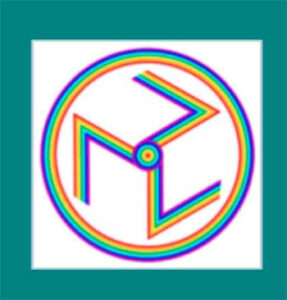
The Antahkarana Symbol – Some Teachers claim that the Antahkarana symbol creates an energy that has a direct effect on the human aura. Activating chakra points in various ways.
The symbol—typically depicted as a three-dimensional cube or seven overlapping circles—is used as a meditation focus, placed under healing tables, or worn as jewelry to facilitate energetic alignment.
Although I see the positive effect that such esoteric symbols become known to a wider public, I am personally quite critical of the watering-down and commercialisation that is happening nowadays. The antahkarana is not built through purchasing symbols or attending weekend workshops but through sustained meditation, ethical refinement, and selfless service.
I have used this Anthakarana symbol myself as a Yantra, a focus in meditation, but I have never seen any mention of such a symbol in the original Wisdom Teachings.
New Age practitioners often integrate antahkarana work with:
Chakra activation – Particularly focusing on the crown chakra as the entry point for higher consciousness.
Lightbody activation – Building the merkaba or light vehicle for interdimensional travel.
DNA activation – Awakening dormant spiritual capacities encoded in genetic structure.
Grid work – Connecting personal antahkarana with planetary and cosmic energy grids.
A word of Caution.
The democratization of esoteric teachings involves both benefits and concerns:
Greater accessibility allows more people to engage with transformative practices previously restricted to initiates. Personal experimentation replaces dogmatic authority.
Removal of traditional safeguards and guided gradual training can lead to spiritual bypassing, premature energetic opening, inflation, and confusion between psychological projection and genuine spiritual contact. The emphasis on rapid ascension may create unrealistic expectations and spiritual materialism.
But hey! Who am I to criticize what is! (😉)
~
~~
~
listen ➡
Contemporary Application of Anthakarana Teachings.
I feel that this ancient teaching offers:
—A Map of Consciousness Development:
Understanding the progression from ordinary awareness to integrated soul-consciousness provides orientation for the spiritual path.
—Practical Techniques:
Meditation practices focused on building upward connection while grounding in the body create vertical integration essential for psychological health.
—A Ethical Framework:
The emphasis on purification and service prevents spiritual practice from becoming self-indulgent navel-gazing.
Integration of Psychology and Spirituality: The antahkarana concept bridges Eastern metaphysics with Western psychological understanding of personality development and integration.
listen ➡
My Conclusion.
The Bridge That Must Be Built.
From its origins as a technical term in Vedic psychology the Anthakarana Teaching has proven remarkably adaptable while retaining core insights about consciousness development.
At its heart, the teaching addresses a universal human need: to integrate ordinary ego-consciousness with transcendent awareness without abandoning either. We need both functional personality and soul connection, both grounded embodiment and spiritual aspiration, both individual autonomy and unity consciousness.
The antahkarana—whether understood as the purified four-fold mind, the Rainbow Bridge between planes, or the activated vertical channel connecting dimensions—represents the human capacity to consciously participate in our own evolution. We are not passive recipients of grace or victims of mechanical laws but active co-creators of the connection between matter and spirit.
The multiplicity of frameworks reflects the multifaceted nature of human consciousness itself. Vedic precision maps the psychological terrain. Theosophical cosmology provides inspirational vision. New Age accessibility invites widespread experimentation. Each serves different needs at different stages of development.
What matters ultimately is not which framework one adopts but whether the practice actually bridges the gap it claims to address.
—Does meditation create genuine connection with something beyond ego-consciousness?
—Does ethical refinement actually purify the instrument of perception?
—Does service shift identification from personal to collective welfare?
Answering those questions will show if Crossing the Rainbow Bridge is real or a spiritual phantasy. That is how i see it.
The Rainbow Bridge—constructed through conscious effort—“awaits building”.
The materials are a sincere heart, focussed attention, true aspiration, and sustained practice.
The blueprint has been provided through multiple traditions. The work belongs to each individual seeking integration of the divided self into conscious wholeness.
Let’s roll up our sleeves my friends, this work is cut out for us.
Let’s do the job well.