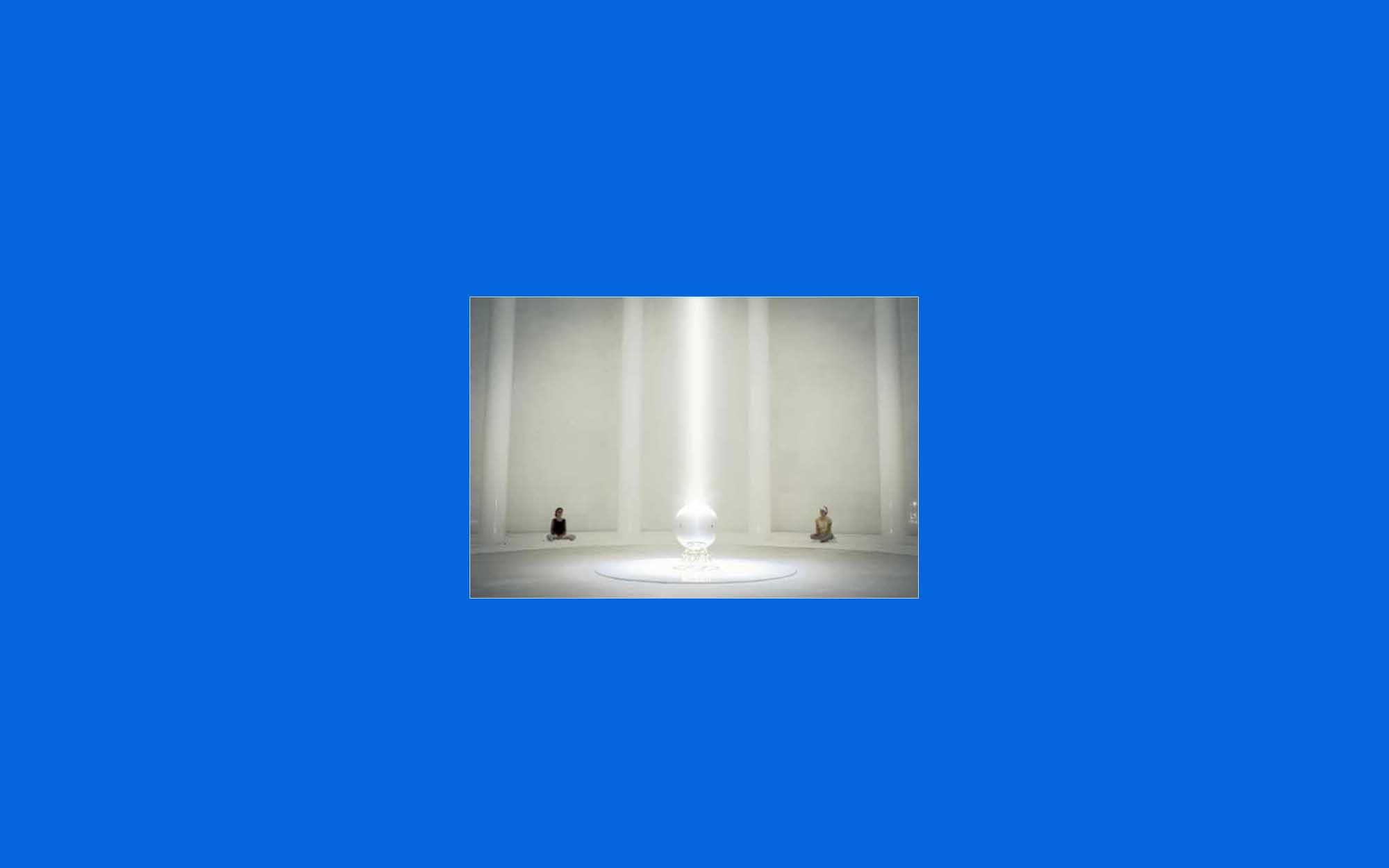
Die ganze Schöpfung mit Geist erfüllen.
Matrimandir, Friedrich Hegel, contemplation and me.
Yesterday morning I woke up from a good night’s sleep with this intriguing sentence on my mind:
“Die ganze Schöpfung mit Geist erfüllen.”
Although born and raised in Austria, I have never been a big fan of the German language. As a matter of fact I have spoken German only on rare occasions during the last 25 years of so.
I talk, write, think, and dream in English, American English, to be precise.
I like it that way.
This German expression came as a puzzling surprise.
And it lingered on, it did not go away until I decided to take it seriously and find out what it could mean (to me).
Immediately a vivid image of the inner chamber of Matrimandir, the pristine meditation space in Auroville/India, came to my mind – my favorite “place” in all the world.
As well as the German philosopher Friedrich Hegel, who wrote a very interesting – but difficult to read – book about the meaning of “Geist.”
But what about “me,” I asked. “What does it all have to do with me?”
And the more I contemplated this puzzle, the more I realized that my regular activity on this blog – contemplating various essential topics of spirituality, the world, and cutting-edge technology – has a lot to do with “filling all creation with consciousness.”
Which is a very rough translation of: “Die ganze Schöpfung mit Geist erfüllen.”
That’s the short answer. 😉
~
~~~
~
The Inner Chamber of Matrimandir in Auroville, India.
The so called Inner Chamber is the most extraordinary, pristine sacred space I have ever experienced in my lifetime, period!.
Besides being my favorite place to meditate whenever I have been in Auroville, it also has great symbolic significance concerning the evolution of Consciousness and Life – capital letters 😉 – that I wish to express here.
Now, what is Auroville?
Auroville
Auroville in Tamil Nadu, Southern India is an experimental township based on spiritual principles and ideals of wholeness of consciousness. Approximately 3000 people from 54 nations live and work there. Plus – over the years – many thousands of short- & long-term guests and friends from all over the world.
Fueled by the spiritual impulse of Sri Aurobindo’s Integral Yoga and envisioned in very specific words 1954 in “The Dream” by Mirra Alfassa – known as The Mother – Aurobindo’s spiritual companion:
“There should be somewhere on earth a place which no nation could claim as its own, where all human beings of goodwill who have a sincere aspiration could live freely as citizens of the world and obey one single authority, that of the supreme Truth … “.
The Charter of Auroville
as formulated by the Mother, set forth
the intention and goal of this experiment
Auroville belongs to nobody in particular. Auroville belongs to humanity as a whole. But, to live in Auroville, one must be a willing servitor of the Divine Consciousness.
Auroville will be the place of an unending education, of constant progress, and a youth that never ages.
Auroville wants to be the bridge between the past and the future. Taking advantage of all discoveries from without and from within, Auroville will boldly spring towards future realization.
Auroville will be a site of material and spiritual researches for a living embodiment of an actual human unity.”
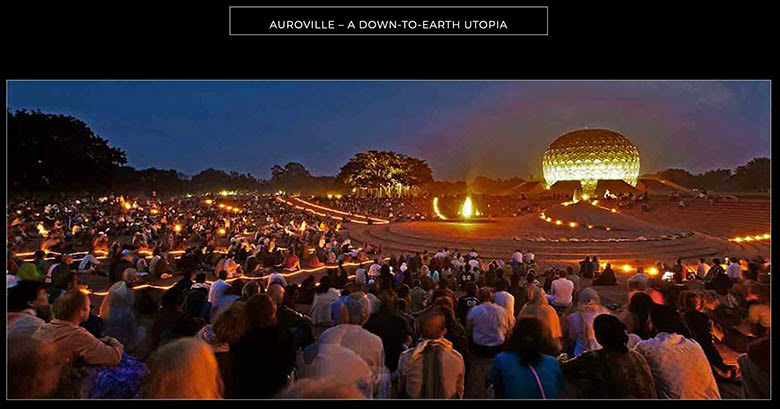
Auroville – a down-to-earth utopia
The Matrimandir
The Matrimandir – the soul of Auroville – is dedicated to the Universal Mother archetype, a divine presence and being that has been revered across cultures throughout history, albeit under different names – Isis, Pachamama, Kwannon, Aditi, Virgin Mary, and many more.
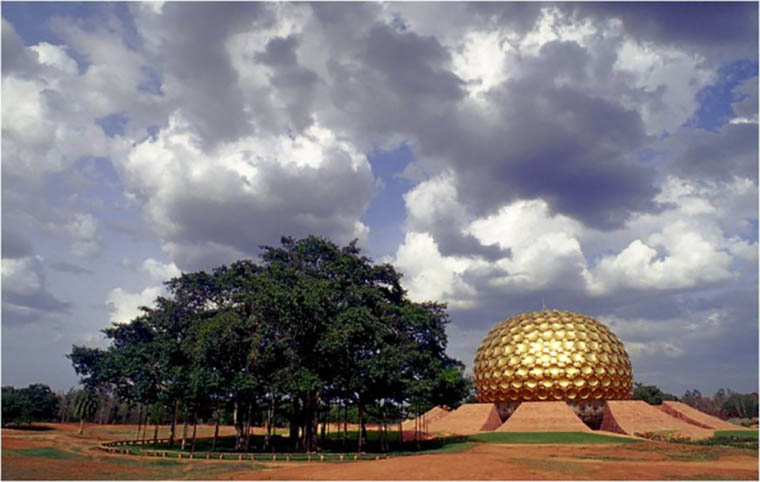
However, Matrimandir isn’t dedicated to a particular incarnation or emanation of the Mother. It represents the principle of the Mother, the creative and realizing force in the universe.
According to Sri Aurobindo’s teaching, the ‘Mother’ concept stands for the great evolutionary, conscious and intelligent principle of Life, the Universal Mother, – which seeks to help humanity move beyond its present limitations into the next step of its evolutionary adventure, the supramental consciousness.
The Matrimandir is surrounded by a large garden, which is divided into twelve sections representing the qualities of the Divine Mother.
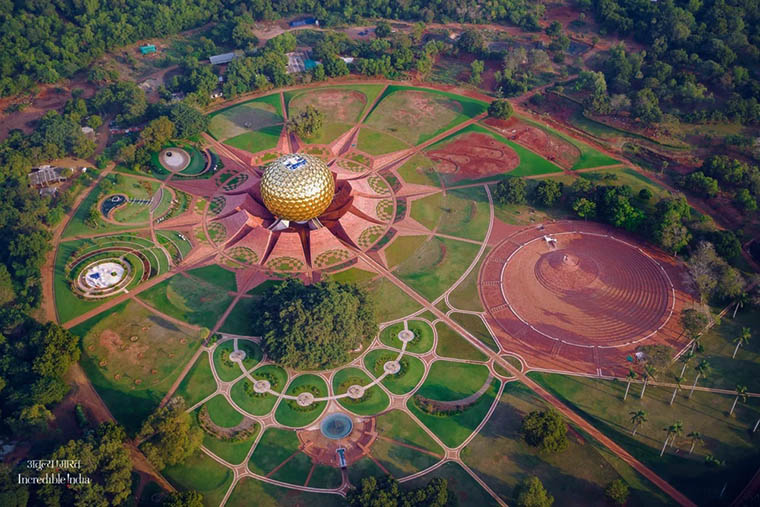
These qualities include peace, power, knowledge, beauty, love, joy, harmony, sincerity, humility, gratitude, perseverance, and aspiration. Each garden is designed to reflect the qualities it represents, and visitors are invited to spend time in each garden and contemplate the qualities they embody.
The Matrimandir itself is a large golden sphere based on sacred geometry and very exact measurements given by Mirra Alfassa’s visions in 1970. The construction began in 1971, built by the non-professional members of the community. as well as people from the surrounding Tamil villages. It was completed in 2008.
The Matrimandir is not a traditional temple or a place of worship, but rather a space for individual meditation, of contemplation and concentration. It is a place where one can go to connect with their inner self and experience silence.
The Inner Chamber of the Matrimandir
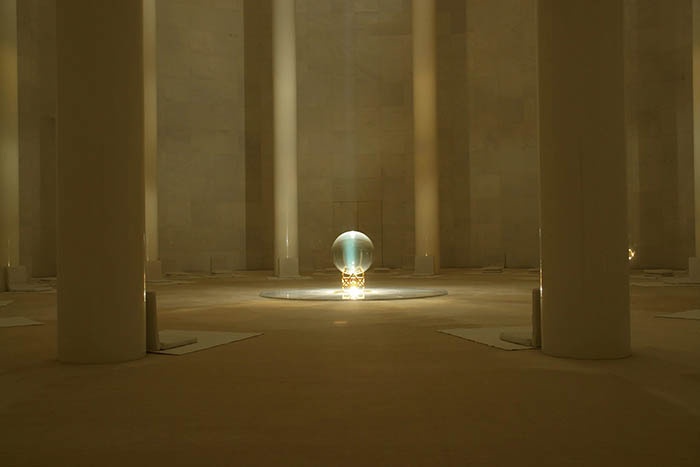
The Inner Chamber of the Matrimandir is a silent space dedicated solely to individual concentration, meditation, and finding one’s higher consciousness.
The Camber had been envisioned by Mirra Alfassa (“The Mother”) as the Soul of the soul of Auroville.
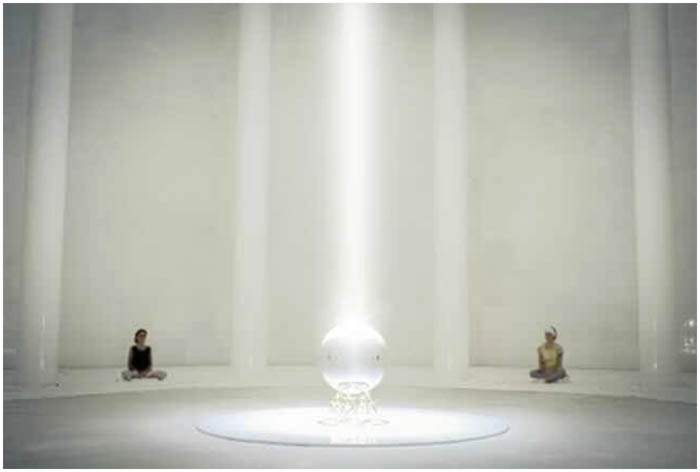
It is designed for inner transformation, free from organized religious connotations or specific rituals – no prayers or incense, flowers, pictures or other conventual esoteric accessories – fostering a direct, personal connection to the Divine in an environment of intense silence.
No words have been spoken in the chamber since its completion.
The chamber is designed as an all-white, air-conditioned space aimed at calming the mind and allowing for deep introspection.
It serves as a place for individuals to connect with the Supramental Consciousness, which is considered the next step in the development of humankind.
The Crystal Center
A sun-ray is directed via a heliostat through the roof onto a perfect glass globe of 70cm diameter .
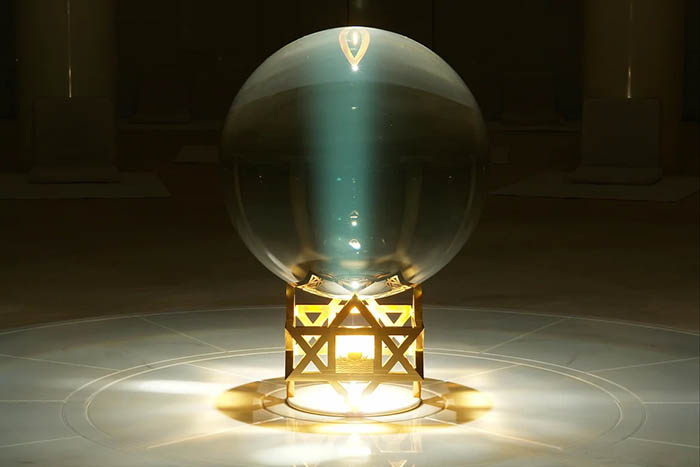
The globe disperses the sun-ray into the chamber and acts as a soft focal point for the still mind, symbolizing the descent of the Supramental Consciousness into matter.
Aurobindo’s Symbol
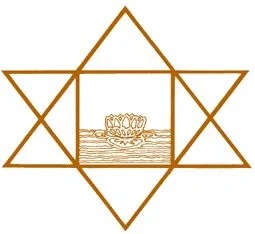
Sri Aurobindo’s symbol represents the union of Divine Grace and human aspiration, resulting in the Supramental Manifestation.
The symbol is composed of two interlocking triangles: the descending triangle signifies Sat-Chit-Ananda (Truth-Consciousness, Existence, and Bliss), while the ascending triangle represents the human response in the forms of Life, Light, and Love.
The intersection of these triangles forms a central square, which symbolizes the perfect manifestation of the new divine creation. At the center of this square is a lotus, representing the archetype of the Avatar of the Supreme, and inside the square is water, which denotes the multiplicity and creation.
Together, these elements illustrate the descent of Divine Consciousness into matter to transform it into a Supramental Reality.
Which – according to Aurobindo – will be the next stage in the evolution of humanity’s consciousness.
.
. . .
.
Hegel
Who is/was Friedrich Hegel
and why does he show up in my early morning contemplation?
Georg Wilhelm Friedrich Hegel (27 August 1770 – 14 November 1831) was a German philosopher and a major figure in the tradition of German Idealism.
His influence on Western philosophy extends across a wide range of topics – from metaphysical issues in epistemology and ontology, to political philosophy, to philosophy of art and philosophy of religion.
His principal achievement was the development of a comprehensive philosophical system, often termed absolute idealism, to account for reality as a unified whole.
Central to this system is the concept of “spirit” (Geist), which Hegel presented as humankind coming to know itself through a historical process of rational development.
From Wikipedia
I guess the mention of “… reality as a unified whole” as well as “… the concept of “spirit” (Geist), which Hegel presented as humankind coming to know itself” made me look closer. It sounds like this guy is talking about familiar and interesting territory.
Self-consciousness, collective consciousness.
Maybe even Consciousness per se.
I confess that I am not a great fan of Western philosophy, which tends to emphasise the logical, rational side of the brain, explaining God & the world and everything in-between from that perspective only.
I love Plato a lot and some of his contemporaries, but then later on …
( Well, I am surely simplifying the whole thing a bit! ) 😉
On the other hand, I respect philosophy as a rigorous tool for training the mind on abstract ideas.
But in the end of the day, pure rational logic is not really my thing, when it comes to understanding existence and consciousness.
Philosophy (from Ancient Greek philosophía, literally ’love of wisdom‘) is a systematic study of general and fundamental questions concerning topics like existence, knowledge, mind, reason, language, and value.
It is a rational and critical inquiry that reflects on its methods and assumptions.
Historically, many of the individual sciences, such as physics and psychology, formed part of philosophy. However, they are considered separate academic disciplines in the modern sense of the term. Influential traditions in the history of philosophy include Western, Arabic–Persian, Indian, and Chinese philosophy.
Western philosophy originated in Ancient Greece and covers a wide area of philosophical subfields.
Indian philosophy combines the spiritual problem of how to reach enlightenment with the exploration of the nature of reality and the ways of arriving at knowledge. Chinese philosophy focuses principally on practical issues about right social conduct, government, and self-cultivation.
Major branches of philosophy are epistemology, ethics, logic, and metaphysics.
– Epistemology studies what knowledge is and how to acquire it.
– Ethics investigates moral principles and what constitutes right conduct.
– Logic is the study of correct reasoning and explores how good arguments can be distinguished from bad ones. – Metaphysics examines the most general features of reality, existence, objects, and properties.
– Other subfields are aesthetics, philosophy of language, philosophy of mind, philosophy of religion, philosophy of science, philosophy of mathematics, philosophy of history, and political philosophy.
From Wikipedia
Phenomenology of Spirit
Friedrich Hegel’s perspective on “Geist”
As far as I understand it, when Hegel talks about Geist – or Spirit – he is referring to a specific aspect of consciousness.
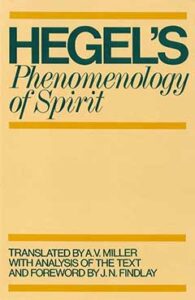 For Hegel, consciousness – he calls it Being – is a collective phenomenon which unites all beings.
When Hegel talks about consciousness, he is not talking about “your” consciousness or “my” consciousness – he is instead talking about the foundational consciousness, the very original, unifying consciousness that allows for our experience in the first place.
Download
This is what Geist is – the all-encompassing and unifying Spirit/Mind of experience. For Hegel, all material reality is a result of Geist, or Mind.
This is what makes Hegel an “idealist,” in club with the other German big-shot philosophers Kant, Fichte and Shelling.
Hegel also came up with a pretty new understanding of “collective-consciousness-as-evolving-entitiy.”
As history unfolds and as human thought progresses, the collective Geist moves towards self-consciousness, Geist/Spirit evolves and grows.
Again, self-consciousness does not refer to you, me, or any particular individual. Self-consciousness refers to the unifying realization of Geist itself.
Once this process has reached an “end”, there is greater self-consciousness.
The culmination of this self-consciousness is Absolute Spirit, which is the full realization of Spirit/Geist.
~
Warning!
Reading Hegel is really hard. His philosophy, even the pieces I have been able to grok, is way more complex than I have been able to explain here.
But for me, it shed light onto the fact that he – and Geist – came up in my mind.
My mind works in mysterious ways, I cherish that!
Associative, networked thinking.
Pattern recognition.
Intuitive insight.
Hegel’s Geist – consciousness becoming aware of itself through dialectical unfolding – is just another metaphor to what the Inner Chamber of Matrimandir stands for.
A seemingly built-in, self-perpetuating process of consciousness that takes place with and without our active participation.
Our individual awareness of it and surrender to it may accelerate collective awakening or delay it.
We always have those choices.
Some people call it:
Freedom.
.
. . .
.
Contemplation
How does contemplation come into the picture here?
Here on my blog I do a lot of contemplation.
Many of the articles on this blog start as an abstract idea or concept, a vivid picture or “gestalt”, a felt sense of what it will be when it is written. Or a sentence that becomes the actual title of the article.
I do not produce that, it “usually comes to me” in the in-between times when I am not asleep anymore but not really woken up. Or the idea literally “drops into my mind” when I am under the shower.
Simple as that.
When i recognize the originality of this idea, I simply open my inner space to that idea, direct my inner awareness steadily onto the topic in a soft-focus all-around way.
Hard to describe, but pretty specific in practice.
The rest is a creative process that unfolds effortlessly over some hours or even days, where the content of the article falls into place, almost without much “thinking or doing.”
Pretty awesome process, actually.
Contemplation is defined as a deep, receptive act of inner observation and “seeing” that transcends intellectual reasoning, often involving a content-free mind directed toward a direct awareness of the divine or ultimate reality.
The word stems from the Latin templum – a sacred space – and the Greek theoria – vision – and it represents a state of mystical awareness where the practitioner holds an idea or object before the mind to experience truth rather than just analyze it.
Contemplation is a somewhat passive, loving gaze where the soul rests in God’s presence without specific thoughts or words.
It is described as a practice of silence and stillness that allows one to connect with a truth greater than oneself, transforming the individual’s perception of reality.
Key characteristics of contemplation:
Receptive Awareness: It involves letting go of habitual thoughts to simply be present to the moment, accepting reality without judgment or critique.
Transformation: The practice aims to rewire the brain and heart to perceive the world with love, moving from an over-analytical mind to a state of divine union or self-realization.
Universal Application: While rooted in various traditions, contemplation is also practiced as a secular method for self-discovery and mental well-being, allowing one to observe the “texture” of existence.
Wikipedia
~
Well, Wikipedia is crowdsourced wisdom, I have great respect for its definition of contemplation.
For me – in the context of writing articles as well as “observing the texture” of any personal situation or challenge I encounter, or any genuine area of interest that attracts my attention, contemplation has become a natural thing.
I can clearly relate it with the experience I had in the Inner Chamber of the Matrimandir.
There the soft focus is on pure consciousness, sitting in the stillness of the Crystal ball’s diffused light. The downpour of supramental consciousness doing all the transformation.
Here with contemplation the soft focus is on an abstract idea or topic. The still and open mind works as a receiver, the brain as a translator and conductor of creative action. The hand on the keyboard is simply the servant of all that what comes thru.
Where it all comes from . . .
is still a precious mystery to me.
But I am grateful that I can be the hand on the keyboard.
And the witness of the whole awesome process.
And the one who is aware of the witnessing.
.
. . .
.
me
Me, I love meditation!
To sit in the center of All That Is
In peace
where is pure consciousness, no form
no duality, no tension, no movement
the empty center,
the still eye of the hurricane of life
Impossible to say in words.
The Tao that can be expressed
is not the eternal Tao.
The name that can be named
is not the eternal name.
The Nameless is the origin of Heaven and Earth.
The Named is the Mother of All Things.
Tao Te Ching – by Lao Tzu
enter the golden tunnel into the place
where is no space
where is no time
where is no mind
just God’s radiant face
Anonymous
I am talking about the practice known as Vipassana, nowadays often simplified as Mindfulness Meditation.
Samatha-vipassanā is the original form of meditation
taught by the Buddha.
Check it out!