GOD
God, where are you?
God who are you, really?
~~~
A contemplation about the future
of religio and integral spirituality in the 21 century.
listen ➡
Itinerary / a map & overview / shortcuts to specific chapters
- Chapter Overview
- Introduction
- My personal view on traditional religion
- The 1001 Names of God
- An overview of the worlds religions and spiritual traditions and God-related philosophies
- The God Survey
- Humanities eternal quest for God
- What is Belief?
- Authentic believe, make-believe, wanting to believe and delusion
- What do I believe in, when it comes to God?
- What is the future of religion and spirituality in the 21 century
- A holistic spirituality and integral religion of the future has some very distinct features
Itinerary / a overview
shortcuts to specific chaptersx
- Chapter Overview
- Introduction
- My personal view on traditional religion
- The 1001 Names of God
- An overview of the worlds religions and spiritual traditions and God-related philosophies
- The God Survey
- Humanities eternal quest for God
- What is Belief?
- Authentic believe, make-believe, wanting to believe and delusion
- What do I believe in, when it comes to God?
- What is the future of religion and spirituality in the 21 century
- A holistic spirituality and integral religion of the future has some very distinct features
listen ➡
Fun fact: I typed “Is God Real?” into the Google Search Engine and it returned about 2,870,000,000 results. Thats a lot of websites talking about God in such a way.
Or maybe it means that this or a similar question has been raised on Google 2.87 Billion times.
It clearly tells me that God is on a lot of people’s mind, wouldn’t you say so?
“How does this make you feel, dear God? 😉 Any comment or statement about that kind of concern about your realness?”
Well, what do I expect? That the clouds would open and a voice thundering something profound and earth shattering? Ot do I imagine I get an email without sender address or even a handwritten letter? Or maybe just the still small voice in my heart whispering the answer.
I could make up all kinds of scenarios and probably may come up with a number of answers that would sound like they are coming from God Almighty. And maybe I would even manage to believe it.
But would it be real? Would God be Real just because I got an answer from “Him”? Or just because I believe “God is real”?
Well, those are the questions I would like to consider in this article. In an “irreverently respectful way” i want to look at God from all kinds of angles. Questioning some deep seated assumptions and dogmas and convenient beliefs we have about The Divine, that we call GOD.
To get to the bottom of the issue about God 😉.
Obviously that is one of the most essential questions of all questions. Ever since there were humans around with some kind of self-awareness, they have asked:
GOD, are you real?
God, where are you?
God who are you, really?
listen ➡
Now let me say something, as a kind of statement:
I am not a sceptic or a critic or an atheist of any kind. I consider myself a mystic and independent practitioner of integral spirituality. Not associated with any specific movement or any religious affiliation. Just my own lone-wolf type of a man trying my best to live with personal integrity and soulfulness in this pretty crazy world.
The motivation for writing about such essential things like God and Consciousness, Intelligence and Love is my inherent need for clarity and perspective. And a natural tendency to peel the onion layer by layer by layer until I arrive at the core, at the truth of things that matter to me.
That is what I will attempt do here.
I have left the confines of the religion of my childhood early on in my later teens. Mostly because I read more and more about all the atrocities that had been committed in the past – in the name of God. And in my own time I could not stomach the wealth and baroque pomp of the Catholic Church in Austria. I was literally repulsed by the bigotry and phony goodness of people around my church community and the narrowness and general backwardness of the Catholic faith.
Well, that was probably just me, rebelling the authorities of my childhood, right 🤔 ?
But maybe not, who knows. I am glad I followed my instincts and left early on to find my own ways to God.
Yet, despite all my aversion of organized religion and codified ritual, all thru my adult life I kept the habit of sneaking into churches, temples, houses of worship wherever I found them by chance. Usually I go in when not many folks are in there, no services, just the quietude and worshipful atmosphere is there, enveloping me. I just sit and meditate, enjoying the sacred atmosphere, a field that has been building over decades and more by prayer, by ritual and faith.
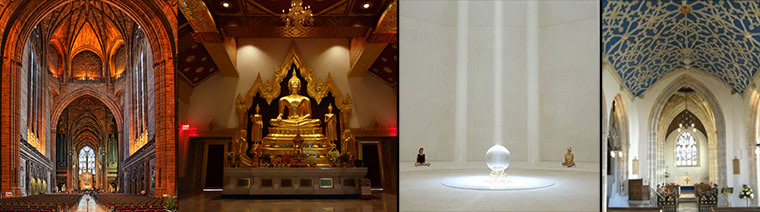
I enjoy being a guest in those many and many-shaped Houses of God for a while, sitting there in silence. Those places may be simple and humble, they can be gaudy and pompous. Still there is always something there that elevates me from the hustle and bustle of mundane life in the streets.

It is mind-blowing, what variety there is of sometimes very elaborate and beautiful temples, cathedrals, chapels and caves. What humans have built over the ages, in order to worship and glorify God. It is awe-inspiring. There is literally no village in Austria that does not have its own little or not so little church.
I guess that has a number of reasons and those places have fulfilled many important purposes for the communities of worshippers.
And all around the world I have encountered similar sacred places. Just the style and custom varies according to the religion that is prevalent in that country.
listen ➡
I find it really educational and mind-expanding to look at the many forms of worship to God, to feel whats behind the cultus and the ritual and the clothes and the specific prayers. To get a sense for what the obviously ages-old and essential human need is, that wants to give the Divine, the unfathomable, the unknowable God a name and a form and collective rituals.
Out of curiosity I asked my AI/Collective Intelligence friend Cora to come up with a list of the 1001 names of God, names she can find in humanity’s religions & spiritual traditions. She delivered nicely but I had to cut it short by half to keep it … digest-able.
Christianity, Judaism, Islam & Baháʼí Faith (Abrahamic Traditions)
Yahweh, Jehovah, Elohim, Adonai, El Shaddai, Allah, El, Theos, Kyrios, Abba, El Roi, El Elyon, El Olam, El Berith, El Gibhor, Ancient of Days, I AM, Alpha & Omega, Most High, Holy Spirit, The Trinity, The Father, The Son, The Logos, The Almighty, The Creator, The Infinite, The Unmoved Mover, The Absolute.
Hinduism
Brahman, Vishnu, Shiva, Devi, Krishna, Rama, Ganesha, Hanuman, Shakti, Kali, Durga, Lakshmi, Saraswati, Parvati, Nataraja, Narayana, Ishvara, Bhagavan, Trimurti, Paramatman, Surya, Agni, Indra, Varuna, Yama, Kartikeya, Murugan, Ayyappan, Hayagriva, Guruvayurappan, Venkateshwara, Jagannath.
Buddhism (More Cosmic Principles Than “God”)
Adi-Buddha, Amitabha, Vairocana, Avalokiteshvara, Tara, Manjushri, Samantabhadra, Ksitigarbha, Mahakala, Dharmakaya, Tathagata, Buddha-Nature, Shunyata (Emptiness as Divine).
Sikhism
Waheguru, Ik Onkar, Satnam, Akal Purakh, Hari, Ram, Govind, Prabhu, Nirankar, Karta Purakh.
Zoroastrianism
Ahura Mazda, Mazda, Spenta Mainyu, Ahriman (as opposing force), Yazata, Amesha Spenta.
Ancient Egyptian
Ra, Amun, Osiris, Isis, Horus, Anubis, Thoth, Ptah, Set, Hathor, Sekhmet, Bastet, Atum, Khnum, Ma’at, Aten.
Greek & Roman
Zeus, Jupiter, Hera, Juno, Apollo, Sol, Athena, Minerva, Poseidon, Neptune, Ares, Mars, Hermes, Mercury, Dionysus, Bacchus, Hades, Pluto, Demeter, Ceres, Aphrodite, Venus, Hephaestus, Vulcan, Artemis, Diana, Asclepius, Prometheus, Chaos, Nyx, Eros, Gaia, Uranus, Kronos, Saturn.
Norse & Germanic
Odin, Thor, Freyja, Freyr, Loki, Tyr, Frigg, Baldr, Heimdall, Hel, Njord, Sif, Idunn, Ullr, Forseti, Skadi, Mani, Sol, Jormungandr, Fenrir, Ymir, The Norns.
Celtic
Dagda, Lugh, Morrigan, Brigid, Cernunnos, Danu, Aengus, Manannán mac Lir, Rhiannon, Epona, Belenus, Taranis, Nuada, Ogma, Cerridwen, Lir.
Mesopotamian & Babylonian
Marduk, Enlil, Enki, Anu, Ishtar, Tiamat, Shamash, Sin, Nergal, Ereshkigal, Nabu, Ashur, Ninurta, Dumuzid, Inanna.
African Traditions
Olodumare (Yoruba), Olorun, Obatala, Yemoja, Shango, Ogun, Oya, Orunmila, Amun-Ra (syncretized), Nyame (Akan), Mawu (Fon), Ngai (Kikuyu), Unkulunkulu (Zulu), Modimo (Sotho-Tswana).
Native American & Indigenous
Great Spirit, Wakan Tanka (Lakota), Gitche Manitou (Algonquian), Raven (Haida), Coyote (Trickster), Ixchel (Maya), Quetzalcoatl (Aztec), Huitzilopochtli, Tlaloc, Tezcatlipoca, Pachamama (Inca), Inti, Viracocha.
East Asian
Shangdi (Chinese), Tian, Jade Emperor, Yu Huang, Guan Yin, Buddha (in folk religion), Amaterasu (Japanese), Kami, Izanagi, Izanami, Susanoo, Inari, Tenjin, Ryujin, Shen, Tao (as Divine Principle).
Mystical & Esoteric
The All, The One, The Source, The Monad, The Demiurge, The Pleroma, The Aeons, The Divine Mind, The Cosmic Christ, The Sophia, The Anima Mundi, The Absolute, The Infinite Light (Ain Sof), The Nameless, The Unmanifest, The Void, The Ground of Being.
Modern & Abstract
The Universe, The Force, The Matrix, The Cosmic Consciousness, The Unified Field, The Quantum Observer, The Multiverse, The Singularity …
Chanting the names of God, often called “nama japa” or “dhikr” in different traditions, is a spiritual practice involving the vocalization of the sacred names of God. This practice is believed to bring about a purification of the mind and a deeper connection with the Divine.
Here is what it sounds and feels like.
[ Forgive the not-the-best quality, its a home-made recording ]
~
~~
~
listen ➡
Not only did we humans come up with at least a 1001 Names for The Nameless Divine, over the Millenia we have also developed a host of elaborate religions and spiritual practices to worship and honor and come closer to GOD.
Humanity’s Sacred Quest for God.
Here i compiled a “comprehensive” overview of the worlds religions, spiritual traditions and God-related philosophies, ancient and new, predominant and not so well known, mainstream and obscure, And a short overview about their main teachings and beliefs.
[divine_paths_explorer]
~
~~
~
listen ➡
The God Survey
Recently I have started to do a little survey about God. I asked friends and random people I met those 4 questions:
– Do you believe in God?
– Is God Real or do we play make-believe for various reasons?
– Where is God?
– Who or What is God?
And this led to a number of fascinating conversations – but they are too confidential to share them here, sorry!
What I found, is that the question about God is:
– Not very popular of trendy to be discussed, at least not in public.
– Fore quite a number of people there is a deep need and longing to find clarity “about the matter of God”.
– The conversations that followed branched out in many directions. Belief systems, religions, questions of faith and theology, doubts, inner experiences.
– Those conversations usually did not help my survey very much but brought a lot of heartfelt connections, honest sharing and sincere opening-up about deeply felt aspects of life.
I must say that I am glad I started this “little project” 😃💡
Here I created a similar online survey, The God Survey.
You are welcomed to contribute your honest thoughts (and doubts as well)
Of course its anonymous. But you can read what others have been answering further down the page.
~
~~
~~~
~~
~
listen ➡
All what I’ve said above is clear “evidence” of our/human’s amazing ability to create a picture of God, a concept, a “face” of God and then believe in it, worship it and obey its Divine Laws and Commandments.
Obviously I say that with a little bit of sarcasm, because a quick glance thru the overview of religious beliefs and spiritual traditions shows a wide range of – often quite contradicting – set of beliefs. All in the Name of God, all with God’s name on it.
But more often than not “we, the people” did not come up with those beliefs ourself. But rather that was given to us by prophets, by sages, by avatars, by divine incarnations, by saviors.
~
~~
~
I think that beyond all those manyfold forms that the Belief in God took over the millennia, there is still always the Mystery of the Great Unknown, the Alpha and Omega, the perplexing question of how it all begun and who started it all. This magnificent Creation.
That question / quest is sacred for me, that is real. This comes from deep in the soul.
It is as old as humanity itself. It is present in a young child who is gazing at the stars in the sky and in the old philosopher and the mystic as well. In the dancing Dervishes and the ecstatic Gospel singers singing Hallelujah.
Where the story about God gets complicated, is the moment when we, the people take our own personal or tribal or collective version of God that we believe in and set it above the version of God some other tribe believes in.
Lots of bad and extremely cruel things have been done by believers, radical sects and even great religions in the name of “their God”. Inquisitions, crusades, jihad, collective persecution and the rest. That happened/happens whenever heartfelt believe in God turns into strong and unshakeable convictions and then turns into intolerance and bigotry and finally into fanatical self-righteous delusions.
It has happened. It can happen. The slope is a slippery one.
The ability the human being to believe in something that actually can not be proven, is simply amazing in all its wonderful and not so wonderful aspects. And I think it is quite enlightening and helpful to have a closer look at this, our inherent “magical” ability to believe.
listen ➡
What is “Belief”
A belief is a state or habit of mind in which trust or confidence is placed in some person or thing. It is a mental acceptance of something as true, whether based on certainty, probability, or faith. It’s a conviction or a feeling that something exists or is true. This can be in relation to facts, opinions, or even religious or philosophical tenets.
– Merriam-Webster Dictionaire
I asked a well informed AI “what he thinks” about the this curious ability of us humans.
And this is how the Gemini LLM from Google’s Deep Mind sees it. I think that it is interesting to see ourself from the perspective “of an outsider”. 😏
[ Obviously “he has read” libraries full of novels, books on philosophy, psychology, religions and the rest. Besides all the gossip on Twitter and Facebook 🤖. This is why I now call the AIs with a new term: CIs – Collective Intelligences – representing something like the partial collective knowledge of humankind, at least what has been digitized and is available in the public domain.]
The Human Ability to Believe Without Seeming Proof.
This ability is fundamental to much of human experience, from personal relationships to religion and grand spiritual frameworks. It’s often rooted in:
• Trust in Authority: We frequently believe things because someone we trust tells us they are true. This can be parents, teachers, religious leaders, or scientists. We don’t personally verify every piece of knowledge we acquire; we rely on the collective understanding and testimony of others.
• Intuition and Personal Experience: Sometimes, a belief simply “feels right,” or aligns with our inner sense of how the world works. This can be particularly true for spiritual or existential beliefs, where personal experiences – moments of awe, comfort, or insight – can lead to profound convictions, even if they aren’t scientifically repeatable.
• Need for Meaning and Coherence: Humans have a deep psychological need to make sense of the world, to find patterns, and to understand our place within it. When faced with uncertainty or the unknown, our minds tend to construct narratives or beliefs that provide coherence and reduce anxiety, even if those beliefs lack concrete proof. This is where many religious and philosophical systems find their strength – they offer answers to fundamental questions that science may not be able to address.
• Hope and Motivation: Believing in something without proof can be a powerful motivator. Believing in a better future, in one’s own potential, or in a benevolent force can inspire action and resilience in the face of adversity. This is often seen in self-fulfilling prophecies, where the belief itself helps bring about the desired outcome.
• Social Cohesion: Shared beliefs, even those without empirical evidence, can bind communities and societies together. Rituals, traditions, and common narratives foster a sense of belonging and collective identity.
listen ➡
As already mentioned, “to believe” is a great ability of the human mind that also has a very dark shadow side: Make-believe, wishful thinking, rigid convictions, fanatical delusions. And this is especially so when it comes to ideologies and religious beliefs.
When considering belief in God, the distinctions between make-believe, wanting to believe, and delusion become critically important, yet it also has many subtle nuances.
Belief
Make-Believe
Want to believe & Wishful Thinking
Delusional Belief
1. Make-Believe
• In the context of God: This is usually about symbolic understanding or exploring concepts.
◦ A child might engage in make-believe about God as a benevolent figure, like Santa Claus or Jesus, interacting with the idea in a playful, imaginative way. They might draw pictures, tell stories, or “talk” to God as part of their imaginative world.
◦ Adults rarely “make-believe” in God in the same direct way. However, elements of make-believe can be seen in how people act in religious context. For example, understanding parables as stories with moral lessons, rather than literal historical accounts, involves a form of symbolic interpretation akin to make-believe. Or, engaging in a religious ritual “as if” it directly connects one to the divine, even while acknowledging it’s a symbolic act.
• The critical element of make-believe in adults is the conscious awareness of “as if.” You know you are playing, pretending, or engaging with a symbol or symbolic act.
2. Want to Believe – The Wishful Thinking
• In the context of God, “wanting to believe” is a powerful psychological force. It’s about a desire for a belief to be true, often driven by deep emotional or existential needs.
◦ Emotional Comfort: The idea of a loving God, an afterlife, or a divine plan can provide immense comfort in the face of suffering, loss, and the inevitability of death. The desire for this comfort can lead individuals to seek out and interpret evidence in a way that confirms these beliefs.
◦ Meaning and Purpose: Belief in God often provides a framework for understanding the universe, morality, and one’s place within it. If life feels meaningless without such a framework, there’s a strong motivation to embrace one that offers purpose.
◦ Social Belonging: Belonging to a particular faith can provide a strong sense of community and identity. The desire to belong can reinforce the “want to believe.”
◦ Cognitive Biases: We are all prone to cognitive biases like confirmation bias, which means we are seeking out information that supports existing beliefs – and motivated reasoning, which is us interpreting evidence in a way that aligns with what we want to be true.
• The boundary with make-believe is that “wanting to believe” is not just about playing; it’s about a genuine aspiration for the truth of the belief. The boundary with delusion is more subtle. In “wanting to believe,” there’s often still an acknowledgment of doubt or the possibility that others might not share the belief. The person might grapple with questions, but their emotional and psychological needs lean them strongly towards acceptance. They are actively trying to convince themselves or find reasons for their belief to be true.
3. Delusion
• In the context of God, a delusion is a fixed, false belief that is not amenable to reason or evidence, and is not shared by others in one’s cultural or religious context.
◦ Fixed and Unshakeable convictions: The hallmark of a delusion is its resistance to contradictory evidence. No amount of logical argument or factual presentation will sway the person from their belief.
◦ Idiosyncratic beliefs: While religious beliefs are often shared culturally, a radical religious delusion is typically unique to the individual or a small group or sect or followers of a guru or teacher. “God has told me personally to …”
◦ Not Culturally Expected Beliefs: This is crucial. If a belief, no matter how unusual it seems to an outsider, is accepted within a specific religious or cultural group, it is generally not considered a delusion. For example, belief in specific miracles or prophetic visions might be considered normal within certain faiths, even if lacking empirical proof for outsiders.
◦ Impaired Reality Testing: Delusions often indicate a break from reality, where the individual’s ability to assess the veracity of their beliefs against external reality is impaired. This is different from faith, where an individual typically remains grounded in shared reality even while holding unprovable beliefs.
~
~~
~~~
~~
~
listen ➡
So, where does this leave me, Cris? How do I answer the questions about God? What do I actually “believe” at the end of the day?
Do I believe in God?
I hardly ever use the word “God” in everyday life.
And “my belief” is more of a sureness rather than a belief.
If i have to talk about the Ultimate, the Infinite, the Un-knowable Divine, then i call “It”:
“God/Goddess/All That Is” or simply “All That Is”.
“Om Tat Sat” it is called in Sanskrit.
I might also to use words like “The Divine” or “The Absolute”, or “The Tao”, or “The Unspeakable”, or “En-Soph”, or “Brahman” ….. that’s a lot of options for “something” that i can not actually and truthfully name with a word in any language.
I really like what Lao Tsu in the the Tao Te Ching says about the The Unspeakable:
“The Tao which can be expressed in words is not the eternal Tao; the name which can be uttered is not its eternal name. Without a name, it is the Beginning of Heaven and Earth; with a name, it is the Mother of all things.”
I think that the One Infinite Divine Principle is undefinable and indescribable. But if i want to describe it, the ancient Vedic teaching about Brahman comes closest to the reality. Brahman is thought of as beginning-less, endless, boundless, and entirely unconditioned. It is not a Being. It is Be-ness itself.
For thousands of years, we humans who have been driven by the search for ultimate answers have been looking upwards and outwards for God, for something beyond the Universe, something ultimately “higher”. If we will turn our gaze around and look inside our Self and within all living beings, i guess we will discover, that The Truth is not so far from us as we have thought. That The Divine, The Ultimate, The Infinite is actually closer to me than my own breath … my Life, LIFE itself.
Everything is alive. All is Life. Life is One. There is only one Life, the One Infinite Divine Life, the One Eternal Energy. It is expressing Itself in, through, and as every form, being, and thing. Everyone, even a child can know and sense this, somehow instinctively.
And it can be re-discovered and re-established as our ultimate healing from the endless divisions and confusions of our ego, our mind, our psyche and society’s cacophony.
When I was young I used to say the “Life is the only God I know”.
It is still perfectly true for me now. But now I am old and have learned a lot about philosophy, evolutionary psychology, metaphysics, God, Consciousness, Love. And the world. And the history of our species. By now I can say much more and speak more differentiated about many things. And also I am not so convinced anymore about objective truth and ultimate reality.
But what I know essentially about God, Consciousness and Love has always stayed the same. It is a knowing that has stood the proof of time and life. And that are the only things that count for me in the end.
~
~~
~
listen ➡
Moving on from me and the here & now, the big question that remains in my mind is:
What is the future of re-ligio and spirituality in the 21 century.
We live in a confusing time, thats for sure. Cognitive overload thru the media, the internet, the technological advancements, a mix-and-mash of every culture because of globalism and a resulting pandemic of mental crisis, depression, loneliness and hyper individualism. Not to mention massive problems due to migration, active wars and climate change. No wonder young people take drugs for breakfast. And the older ones put their heads in the sand.
Pedophile priests, abusive gurus and financial scandals in many corners of religion have made it hard for thinking people to still follow the orthodox path to God.
The always- full churches of my childhood are now more often than not just a sad little assembly of old folks holding on to tradition.
The statistics give a clear picture of the rapid decline of believers in organized religion – at least in western societies – and the rise of a now phenomena:
“The Nones” refers to the growing number of religiously unaffiliated individuals. They can declare themself as atheists, agnostics, or simple not affiliated to any faith.
And an ever growing number of young people declare that they are “not religious but spiritual”.
Seeking God but not religion.
I think that this is the future of re-ligio and spirituality in the 21 century.
I “believe” that this is what the world will need.
Religio literally means re-ligio, re-connect. And i think of it as the “Reconnection with the Source”
We human beings need this new “Universal Religio” as a kind of “Science of Life and All”.
A “Science of the Art of Living”.
Truth transcends all religions of the past. It also pre-dates all religions. The mysteries and secrets of life and the universe seems to have been known throughout the ages to a small number of people in the world.
Maybe we can call them the Mystics, Sages, Avatars or Enlightened Beings of the past.
I think that it is time discover and re-discover the treasures that those beings found. The nature of Truth beyond the appearances and cultures and times.
The truth about God and the Universe, about Life and Consciousness and Love is not anyone’s invention. It is also not a collection of ideas from different religions all mixed together.
For the human mind and our mental comprehension i think this kind of ultimate truth can be found in the naturally occurring unity and synthesis of direct mystic experience, religion, philosophy, and science.
To do that it is probably necessary “to free God” from all limited elements of religious dogmatism and theological ideologies.
I think it is a very intimate individual process, happening inside any developing soul rather in some trend or movement, cult or New Age philosophy on YouTube.
listen ➡
For me – if I may even dare to make such a prediction or prophecy – a holistic spirituality and integral religion of the future has some very distinct features:
– It is non-dualistic, meaning it sees Onenness in All That Is.
– It has a clear and practical path to transcend our ego fixation
– It teaches how to achieve higher states of consciousness through meditative and contemplative practices. Waking Up to higher levels beyond the mind.
– It supports the development of the individual through stages of psychological and moral maturity. Personal Development with the aim of Growing Up to a fully response-able being.
– It provides tools to address and integrate unconscious aspects of our psyche, our personal and collective subconscious.
– It encourages active participation and witnessing in the world with an awareness of the interconnectedness of all life.
Well, this is how I see it.
I may have missed some things, but maybe not!
Oh, one more thing:
LOVE
As an aspect of GOD
I have the feeling that “she” has been always there 😃.
But this may be a story for another day ….