

Living from the Heart in times of Upheaval and Uncertainty
Civilian infrastructure destroyed in Iran, a million people displaced in Lebanon, the price of petrol going thru the roof, the Rich get richer every day, bombs raining down on Ukraine since 4 years and 34 days already, thousands of Russian soldiers killed, social media is already addicting 5 year olds, the Palestinian genocide is going on unnoticed, we can not live without our iPhones anymore, in South Sudan 9 million people need humanitarian aid, AI is taking jobs at an exponential rate . . .
. . . shall I go on?
Oh, and on top of all of that, the weather is getting hotter every year . .
With such an onslaught of horrible news coming at you through the media, you might be forgiven to look away, to focus on your own little corner of life, to close your heart to all such suffering and upheaval and uncertainty …
Its understandable that people shut down their heart and get cynical, right?
Not a good solution, I would say, closing down the feeling heart is no good for your heart and no good for the world.
.
. . .
.
In this article I wish to lay down an alternative path to deal with today’s frightening realities, maybe point out some constructive options we can choose.
Here are some of the themes I would like to cover:
– “The Heart” as a metaphor for the qualities of the 4. Chakra
– What do I mean by “Living from the Heart”
– How to deal with uncertainty and fear, violence, alienation and powerlessness
– Inner practices that ground us and allow us to stay open and present – attunement, reflection, mindfulness
– Collective action that affirms our power of change – social witnessing and community connection, speaking truth to power and community organizing
– How to reconcile with the fact that most of the time males are the perpetrators of injustice and violence
– How to heal the masculine / feminine rift inside our own psyche, the “War of the Sexes”
– The essential role of women in nurturing a peace that endures, rooted in relationships and shared humanity
.
. . .
.
Living from the Heart in times of Upheaval and Uncertainty
The Heart as Metaphor
When I speak of “the Heart,” I am not pointing to the fist-sized muscle pumping blood through my chest – although that organ itself is a kind of miracle.
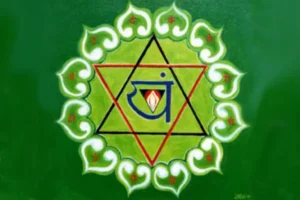
I am pointing to something the yogic traditions have mapped out with remarkable precision thousands of years ago: Anahata, the fourth chakra, located at the center of my chest, the energetic crossroads between the lower three chakras – instinct, pleasure, will – and the upper three chakras – expression, insight, transcendence.
The word Anahata means “unstruck sound.”
The vibration that simply is.
This is not a metaphor for sentimental feelings. The Heart in this sense is a cognitive organ – a way of knowing the world that is neither purely rational nor purely emotional, but something richer than both.
It perceives relationship, resonance, interconnection.
It registers suffering – in myself, in others, in the world – without immediately converting that suffering into either numbness or panic.
The Heart is the capacity to remain present with what is, without collapsing into it and without fleeing from it.
That is a radical and demanding practice. Especially now.
.
. . .
.
What I Mean by Living from the Heart
In therapy sessions I have watched the same drama unfold again and again: a person arrives armored – against grief, against uncertainty, against their own tenderness – and that armor, however reasonable it once was, has become a prison.
Living from the Heart does not mean living in constant emotional exposure, weeping over every headline, burning out on the altar of empathy.
That path leads to compassion fatigue and eventually to precisely the cynicism we wished to avoid.
Living from the Heart means something more subtle, more powerful:
It means staying permeable – allowing what is real to actually touch me – while remaining rooted enough not to be swept away.
It means choosing, again and again, to respond rather than merely react.
It means recognizing that my inner life – how I meet this moment – is not separate from the condition of the world around me. It is a contribution to the world’s condition, probably invisibly but genuinely impactful.
In the language of Carl Jung’s depth psychology, this is the difference between the ego managing experience and the Self inhabiting experience.
The ego wants control. The Heart is comfortable with not-knowing — not because it is naïve, but because it has a different relationship with time, with outcome, with the nature of change.
.
. . .
.
How to Deal with Uncertainty, Fear, Violence, Alienation, and Powerlessness
If I am really honest, I must say that I do not have a real answer here, one that could be applied generally.
After all my years of Vipassana practice, after accompanying many people through their dark passages, after witnessing the world accelerate into this particularly awful chaos of today – I still feel the weight of it, the bewilderment.
And I have learned to trust that feeling. Not to fix it. Not to explain it away. To let it move through me.
Uncertainty
The first step in dealing with overwhelming uncertainty is exactly this – to stop trying to resolve it prematurely.
The mind wants resolution. It wants the story to end cleanly.
But a world in upheaval does not offer clean endings – and reaching for them too quickly produces either false hope or despair, often a cycling between both.
Fear
What Vipassana meditation taught me is that impermanence is not a problem to solve. It is the nature of existence.
When you stop fighting impermanence, something unexpected happens:
Fear changes quality. It does not disappear. But it becomes workable. It becomes information rather than condemnation.
Fear, underneath the noise that it makes, is often asking a simple question:
What do I actually love?
What matters to me?
What am I afraid to lose?
Answer that question — really answer it — and you have found your ground.
Alienation
The antidote to alienation is connection.
But not the frantic, social-media-flavored pseudo-connection of likes and outrage loops in echo chambers.
I mean real connection.
Eye contact, shared silence, the weight of another person’s story actually touching something in me.
Even one such moment in a day is enough to remind my nervous system that I belong to something larger than my own anxiety.
Powerlessness
And powerlessness – which in my opinion is perhaps the most corrosive of all these feelings in the current climate.
Here I would say: Cool down babe, scale down the drama!
The feeling of powerlessness is often generated by comparing our individual capacity to the scale of systemic crisis.
You are not meant to stop the Russian missiles or reverse the rising oceans single-handedly. You are meant to act within your actual sphere – your community, your relationships, your actual choices – with full presence and integrity.
That is wisdom, the understanding about where your agency actually lives.
.
. . .
.
Inner Practices that can ground us
I want to be specific here, because vague spiritual advice is good for not much.
Attunement
This is the practice of coming back into felt contact with my own body.
Not analyzing it. Not performing wellness. Just arriving.
– My hand on my chest. Three slow breaths.
– Asking myself: what is actually here right now?
Five minutes of this in the morning changes the entire day’s nervous system baseline.
Reflection
Not the obsessive rumination and frantic searching for answers that we may confuse with introspection in anxious our minds, but genuine contemplative reflection.
The Anthroposophical practice of Rückschau, the evening review, revisiting the day’s events as if watching them from a slight distance, without judgment, with genuine curiosity.
– What moved through me today?
– What did I miss?
– Where was I absent?
This practice, done consistently, builds a kind of inner witness — the part of me that can hold my experience without being entirely consumed by it.
Mindfulness
I actually prefer to use the Pali word sati, which means something like “clear remembering.”
– Remembering what? Remembering that I am here.
– Remembering that this breath is happening.
– Remembering that the present moment – even when it is difficult – is the only actual ground you have.
Everything else is memory or projection.
These are not escapes from the world’s pain. They are precisely what equips you to remain in contact with it.
.
. . .
.
Collective Action: The Power We Share
There is a particular lie that our late-stage capitalism tells: That the market directs change. That change happens through our choices of consumptions – “buy organic, drive electric, vote correctly.” And that structural, collective action is either naive or futile.
I do not believe that.
What I have seen, looking back across decades of grassroots community work and social engagement around the world, is that something powerful is happening when people gather in shared purpose.
Not virtually — physically.
In the same room, around the same circle, looking into each other’s faces. The nervous systems synchronize. A kind of distributed intelligence emerges that no individual possesses alone.
.
. . .
.
Social witnessing
The practice of being genuinely seen in your concern, your grief, your rage about some injustice – this is deeply therapeutic.
And it is also politically productive.
When people discover they are not alone in what they feel, the isolation that sustains passive acceptance breaks open.
.
. . .
.
Speaking truth to power
It is not only about confronting institutions, though that matters enormously.
It begins with the much harder, more intimate practice of speaking my actual truth in the relationships closest to me.
The coward in all of us wants to keep the peace by swallowing what is real. But swallowed truth becomes resentment, and resentment becomes the very disconnection that feeds collective apathy.
.
. . .
.
Community organizing
Showing up consistently, doing unglamorous work, building trust slowly – this is the long game.
And the long game is the only game that changes systems rather than merely reacting to them.
.
. . .
.
About Men and the Perpetration of Violence
This is the topic that I approach most carefully – also because I am male. Not to protect anyone’s comfort, but because the temptation here is to be either self-flagellating or defensively dismissive, and neither serves the truth.
The reality of the facts is pretty clear. The overwhelming majority of political violence, military aggression, domestic abuse, and structural exploitation across cultures, across centuries, has been organized, led, and enacted by men. By us.
Lets sit with that, lets sink it in.
I notice, in myself and in the men I have worked with therapeutically, a particular wound at the core of what we have been taught to call masculinity:
– A dissociation from vulnerability, from tenderness, from the relational wisdom that the Heart offers.
– We have been trained by culture, by fathers who were trained by their fathers, to turn feeling into action, to replace grief with aggression, to experience the full spectrum of human emotion as a kind of weakness that requires management.
This is not an excuse. It is a diagnosis. And like all accurate diagnoses, it points toward where healing is actually possible.
The men who have done the deepest work I have witnessed are those who allowed themselves to grieve.
Not perform grief. Actually grieve the cost of the armoring.
– The intimacy lost.
– The children kept at arm’s length.
– The wars fought in the job and in the bedrooms and maybe on actual battlefields because no one taught us another way.
That grief is the beginning of something different.
.
. . .
.
Healing the Masculine-Feminine Rift Within
Carl Jung understood something very essential: every psyche – regardless of the body it inhabits – contains both masculine and feminine principles, what he called the animus and anima. And in most of us, these principles are at war.
The inner masculine – when healthy – is the capacity for clarity, discernment, directed action, the holding of boundaries.
The inner feminine – when healthy – is the capacity for receptivity, relational intelligence, cyclical knowing, the willingness to be moved.
When these are split – when the masculine becomes domination and the feminine becomes mere accommodation and acceptance – we end up sooner than later with the “War of the Sexes.”
And this war is enacted endlessly in intimate partnerships, in politics, in the relationship between humanity and the living Earth itself.
Healing this rift is not about making men more “feminine” or women more “masculine” in any superficial sense.
It is about recovering the full spectrum of capacity in every human being. The warrior who can weep. The nurturer who can say no. The leader who listens before deciding. The follower who knows when to act.
This healing happens in the body, not just the mind. It happens in the quality of one’s intimate relationships.
It happens in how one can handle uncertainty – whether one immediately reaches for control, or whether one can tolerate the fertile darkness of not-yet-knowing.
In meditation – particularly in the deeper stages of Vipassana practice – this rift becomes visible as a kind of internal tension, a clenching against the flow of experience.
And as that clenching slowly releases, what emerges is not passivity but something far more alive:
What emerges is a responsive presence, grounded and open simultaneously.
.
. . .
.
“Women have a special capacity to lead us to a more Peaceful World, with compassion, affection and kindness.
And there is no more important time for that than this moment.”
Dalai Lama
The Essential Role of Women in creating a peace that endures
The Dalai Lama’s words are neither flattery nor romanticism. They point at something I have observed across my life:
That women – and particularly those women who have integrated their own wounds, their own power, their own full complexity – carry a kind of social intelligence that the current world is desperately hungry for.
This is not about women being “naturally peaceful” – that is its own kind of diminishment, another cage with a prettier name. Women are as capable as men of cruelty, of ego, of destructive competition. History, when honestly told, shows this.
But something is structurally different.
Because women have been forced, by centuries of exclusion from formal power, to build and sustain the relational fabric that holds communities together.
The informal life-enhancing networks of mutual aid. The skills of mediation, of holding contradictions, of finding the third path when two armed positions that stubbornly face each other down.
These are not soft skills.
In the world we are entering – where the failures of domination-based power are becoming catastrophically visible – these are the skills of survival.
And I see something else. The feminine principle – inside both women and men – has a particular close relationship with continuity, with the long view, with what endures beyond the individual ego’s brief tenure.
Native peoples called it “thinking in seven generations.”
Perhaps because a body that can carry life must naturally think in longer cycles.
The peace that endures – not the peace that is negotiated at gunpoint and lasts until the next grievance – is built from relationship.
From the patient, unglamorous, daily work of actually seeing the other person. Of finding the human face beneath the role, the ideology, the uniform.
Women have been practicing this for millennia, largely uncredited.
The world is finally beginning to notice it needs them.
.
. . .
.
What the Heart Knows
I am writing this in my small fishing village on the Pacific coast of Costa Rica. The sun is going down over the water, painting everything in a glorious gold and pink. Somewhere in the jungle, the howler monkeys are beginning their evening chorus.

All is peace here this evening.
And somewhere else, the world is on fire.
Both of these things are true simultaneously. This is not contradiction – it is the actual texture of being alive in our time.
The Heart’s capacity is exactly this: to hold both realities at the same time.
– To be genuinely moved by the suffering without toning down the beauty.
– To be genuinely delighted by the beauty without denying the suffering.
– To remain, in some essential way, intact – not because i have protected myself from the world’s pain, but because I have learned to digest it, metabolize it, to let it pass through me.
– To neither store it as bitterness nor expel it as despair.
Living from the Heart is not a destination. It is a direction.
A re-commitment, every morning, to remain permeable like a membrane.
– To choose presence over performance.
– To trust that my small, faithful, openhearted engagement with the slice of life I actually inhabit is not irrelevant.
– That my contribution makes a difference, that it ripples, in ways invisible to me, into the larger field of the collective consciousness of manking.
The unstruck sound.
Anahata.
It is simply what remains when everything else goes quiet.
Lets Trust It.
Anahata – the Heart Chakra